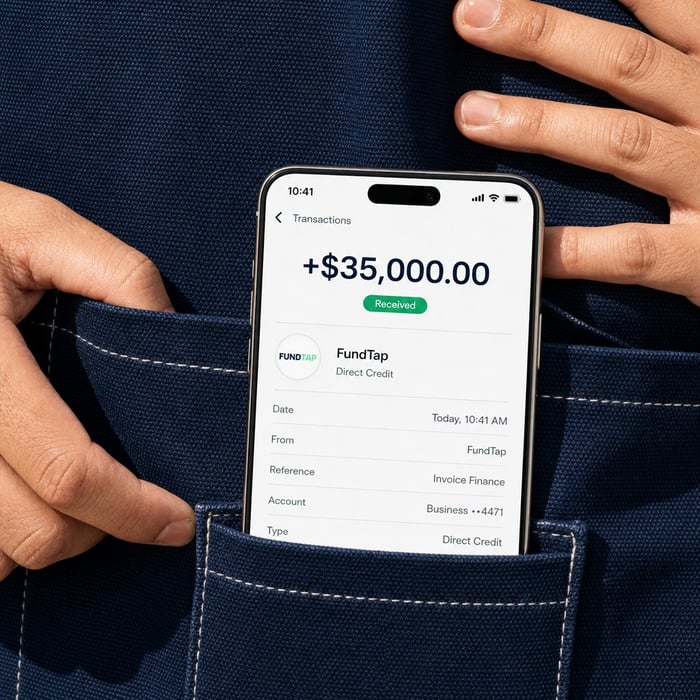
It isn't unusual for a business to have done the work, sent the invoice and still be waiting 30, 60 or 90 days to be paid. Meanwhile wages, materials and suppliers are due now. That gap between invoicing and getting paid is where invoice finance comes in.
Invoice finance gives a business access to money from unpaid customer invoices before those invoices are paid. Depending on the provider, the business may receive an advance against an invoice or sell the invoice to a funder. With FundTap, you choose an eligible invoice, see the fee before you confirm and, once approved, receive up to 90% of the invoice value within 2 hours. Your customers continue to pay you as usual.
What is invoice finance?
Invoice finance is a broad term for funding linked to unpaid invoices. Instead of waiting for a customer to pay on their terms, a business brings some of that money forward and repays the funder when the invoice falls due.
You may also see it called invoice financing or invoice funding. The terms are commonly used for the same broad category of funding. The structure, fees and terms vary by provider.
"Invoice finance isn't about borrowing, it's about timing. The business has already done the work and earned the money; we just close the gap between earning it and being able to use it."
Matt Peacey, Founder & CEO, FundTap
Invoice finance explained
You've completed the work and sent the invoice. Your customer has time to pay, but wages, materials and suppliers may be due sooner. Invoice finance brings some of that money forward, so you can cover costs or get started on the next job.
Providers use different arrangements. Some fund individual invoices, while others offer funding against a larger share of a business's invoices. Fees, customer notification and collection arrangements also vary, so it pays to understand exactly how an arrangement works before you sign up.
How does invoice finance work?
With FundTap, the process runs through your accounting software. Xero, MYOB, QuickBooks and Reckon all connect. If you're not on any of them, that isn't a no: talk to us about your options.
The following chart captures the main steps with FundTap:
- Step 1Check eligibilityConnect your accounting software. A few minutes, no obligation.
- Step 2Get approvedFundTap's approvals team reviews you, usually within a day.
- Step 3Pick an invoiceOne, several, or none. Whenever you need it.
- Step 4See the feeThe exact fee before you confirm, worked out for that invoice and the days until it's due.
- Step 5Get fundedOnce approved, FundTap funds you within 2 hours.
- Step 6Ready againOne direct debit on the invoice due date, for what was funded plus the fee you were quoted.
How is invoice finance with FundTap structured?
FundTap advances money against the invoices you choose, confidentially. Your customers continue to pay you directly, and your clients are never contacted by FundTap. You can fund any share of an invoice rather than all of it, so if 20% is all the week needs, you can fund 20% for a smaller fee.
On the invoice due date, FundTap collects the advance plus the fee by direct debit. If your customer pays early, you can bring your repayment date forward in the portal and the fee reduces. If payment is delayed, you can extend the repayment date by up to 7 days in the portal.
How much does invoice finance cost?
The cost depends on the provider and agreement. Some charge a fee per invoice; others may charge service fees, interest, minimum fees or ongoing charges. Ask for the total cost and how it changes if repayment is early or late.
FundTap charges one flat fee per invoice you fund, from 4%. It is made up of a base, plus a small amount for each day to the due date, and it is quoted in full before you confirm. There are no establishment fees, no monthly service charges, no break fees and no lock-in. FundTap doesn't charge interest, and nothing is owing while you're not using it.
The fee is recalculated for the actual number of days the funding runs, so it moves in both directions: if your customer pays early it comes down, and if the repayment date moves out it goes up. Connecting your accounting software earns the standard fee. Without accounting software, the fee starts higher.
Types of invoice finance
If your business invoices customers on terms, there are a few broad ways to turn those invoices into cash sooner:
- Selective invoice finance: You choose individual invoices to fund, when you need to. This is how FundTap works, with one fee per invoice and nothing to pay in the months you don't use it.
- Whole-of-ledger facilities: Funding is provided against a larger share of a business's invoices on an ongoing basis. If you're funding most of your ledger continuously, a whole-of-ledger facility or a bank line will usually price better.
- Invoice factoring: The business sells its invoices to a third party, which then collects payment from the business's customers directly, so the customers know.
Selective invoice finance
Selective invoice finance suits businesses with an occasional or seasonal gap between paying costs and getting paid. Because you pay one fee per invoice you fund and nothing in the months you don't, funding occasionally usually works out cheaper than a facility you pay for every month whether you draw on it or not.
Invoice factoring
Factoring is one form of invoice finance in which a provider purchases invoices and may also manage collection. It can suit larger businesses funding continuously, but your customers will know a third party is involved.
Invoice finance vs invoice factoring: what's the difference?
Invoice finance and factoring both bring an invoice forward. The difference is in who owns the invoice, who collects payment and whether your customers know.
Key differences: Invoice finance (like FundTap) advances money against your invoices confidentially, and your customers pay you as normal. Invoice factoring involves selling your invoices to a third party who then collects payment from your customers directly, so your customers know.
| FundTap | Factoring arrangements | |
|---|---|---|
| Which invoices are funded? | You choose eligible invoices. | Depends on the provider and agreement. |
| Who receives the customer payment? | Your customer pays you directly. | The factor may collect payment directly. |
| Is the customer contacted? | Your clients are never contacted by FundTap. | Disclosure and contact vary by arrangement. |
| Who bears non-payment risk? | Your business remains responsible for repayment. | Check whether the agreement is recourse or non-recourse. |
Invoice finance and factoring both turn unpaid invoices into cash, but differ in confidentiality, collection and who carries the risk if a customer doesn't pay.
Compare invoice finance and factoring
Invoice finance vs other small business funding
Invoice finance is one of several ways to cover a short-term cash gap. Each option suits a different need, and terms vary by provider:
| Option | Usually suits | Things to check |
|---|---|---|
| Invoice finance | Bridging the wait between invoicing and getting paid | The fee per invoice, which invoices can be funded and whether customers are contacted |
| Business loan | One-off investments such as equipment or expansion | Fixed repayments, the loan term and any security or guarantee required |
| Overdraft | An ongoing buffer for day-to-day spending | Setup time, ongoing fees, interest and any security required |
| Business credit card | Small, short expenses | Interest if the balance isn't cleared each statement period |
| Invoice factoring | Businesses happy for a third party to manage collections | Customer notification, ledger commitments and recourse terms |
Invoice finance can also sit alongside other finance. Some businesses keep a smaller overdraft or loan and use invoice finance for the gaps that come and go.
Benefits of invoice finance
Invoice finance can help when the need is tied to the time between sending an invoice and getting paid. For businesses that invoice on terms, the main benefits are:
- Fast access to money you've already earned: Once approved, FundTap funds you within 2 hours, so you're not waiting 30 or 60 days for money that is already owed to you.
- You stay in control: You choose which invoice to fund, how long and how much. There is no requirement to fund every invoice, and one invoice is enough.
- Upfront, flat pricing: You see the exact fee before you confirm, with no setup fees, monthly fees or lock-ins.
- Your customer relationships are unchanged: Your customers pay you as normal and are never contacted by FundTap.
Drawbacks of invoice finance
Invoice finance has a cost, and it is important to understand the terms before you commit:
- You remain responsible for repayment: Your business remains responsible for repayment if your customer pays late or does not pay. If you expect a payment delay, extend your repayment date in the portal before the due date, or contact FundTap to discuss your options.
- The cost can change: The fee is recalculated for the actual number of days the funding runs. If the repayment date moves out, those extra days are added and the fee goes up.
- Security and other agreements matter: If another lender already has a security interest over your invoices, discuss it with the provider before proceeding.
- Funding is limited to your invoices: You can only fund against eligible invoices you've raised, so it won't cover a large one-off investment such as equipment or a multi-year expansion.
- You still manage collections: Your customers pay you as normal, so following up late payers stays with you. That also means no one else contacts your customers.
- It will not fix a structural problem: Invoice finance can bridge a payment-timing gap. If your business is consistently losing money or has no eligible invoices, another solution may be more appropriate.
Read when invoice finance does not make sense
Is invoice finance right for your business?
Invoice finance is usually a good fit when the business is viable but the timing of payments is tight:
- Your customers pay on 30 to 60-day terms while wages, suppliers and materials are due now.
- You're growing, and costs such as hiring, stock or starting a new job land before customers pay.
- A large customer insists on long payment terms and you want to keep the account.
- Your revenue is seasonal or lumpy, and a few big invoices decide how the month goes.
- You want to fund the occasional gap without paying for a facility every month.
It's usually the wrong tool when:
- You don't have invoices yet and need money before you can deliver the work.
- The business is consistently losing money, rather than waiting to be paid.
- Your invoices are often disputed, or your customers regularly don't pay.
- You need long-term capital for equipment or expansion, rather than a short bridge.
A simple test: if the cash shortfall would be solved once the invoice is paid, invoice finance may suit. If it wouldn't, look at other options first.
Invoice finance example
A business completes a job and raises a $4,500 invoice on 30-day terms. It needs to pay suppliers before the customer's payment arrives, so it selects the invoice in FundTap and sees the fee before confirming.
Once approved, FundTap pays up to 90% of the invoice value, $4,050, into the business's account within 2 hours. When the customer pays the invoice on the due date, FundTap direct debits the $4,050 advance plus the $235 fee, $4,285 in total, leaving the business the remaining $215 of its $4,500 invoice.
| Invoice raised | Funded | Due date (day 30) | Total | |
|---|---|---|---|---|
| What happens | The business raises a $4,500 invoice on 30-day terms, selects it in FundTap and is quoted a $235 fee. | Once approved, FundTap pays $4,050 (90%) into the business's account within 2 hours. | The customer pays $4,500. FundTap direct debits $4,285: the $4,050 advance plus the $235 fee. | The business has received the full $4,500 invoice value, less the $235 fee. |
| Cash flow | $0 | +$4,050 | +$215 | $4,265 |
This example uses the figures from FundTap's pricing page. Your exact fee depends on the invoice and the days until it's due, and is quoted before you accept funding.
Which businesses benefit the most from invoice finance?
Invoice finance can suit any business that issues invoices for work already completed and needs access to money before customers pay. That includes construction, staffing, professional services, transport, wholesale, manufacturing and agriculture. For example:
- A trades business needs materials for its next job while an earlier invoice is still outstanding.
- A staffing business pays contractors weekly while clients pay monthly.
- A distributor has an opportunity to purchase stock before a customer's payment arrives.
- An agriculture business has a big seasonal invoice, and the buyer pays on the 20th of the following month.
- A wholesaler pays its suppliers upfront but invoices its own customers on terms.
- A growing business wants to take on a bigger contract or a new product line without waiting for earlier invoices to clear.
Two FundTap customers describe how they use it:
"FundTap has enabled us to grow relatively quickly. If we waited for traditional lending, we would've been 6-7 months behind where we are now."
Pranav Maharaj, founder of Outre Clothing
"We are able to achieve scalability more easily with FundTap, making cost savings when ordering larger volumes of ingredients, and having capital available for huge packaging runs with long lead times."
Sarah, Co-Founder of YUM
How to qualify for invoice finance
FundTap funds businesses actively trading in New Zealand or Australia that invoice their customers on terms, whether those customers are businesses or consumers. Four things matter:
- You're actively trading: A registered business or a sole trader in New Zealand or Australia, working now.
- You invoice your customers on terms: They can be other businesses or consumers.
- The invoice is for work already done and isn't paid yet: An invoice already past its due date can't be funded. Most of what FundTap funds is due within 60 days, and longer is considered case by case.
- Your accounts are in order: Xero, MYOB, QuickBooks and Reckon all connect.
There is no minimum number of invoices, and the smallest invoice FundTap can fund is $300. Approval is not automatic.
FundTap works with businesses across New Zealand and Australia. For local payment terms and industries, see invoice finance in Auckland, Christchurch and Hamilton.
Check the full eligibility criteria
How to apply for invoice finance
Applying with FundTap starts with checking eligibility and connecting your accounting software, which takes a few minutes with no obligation. FundTap's approvals team then reviews your business, usually within a day. Once you're approved, you can choose an invoice to fund whenever you need it.
Comparing providers in Australia? Our guide to the best invoice finance options for Australian small businesses sets out what to check on fees, contracts and customer contact.
Get paid for work you've already done with FundTap
FundTap turns your unpaid invoices into cash, within 2 hours of approval. Connect your accounting software, pick the invoice you want funded and see the exact fee before you confirm. Your customer is never contacted, and once an invoice is repaid your funding limit is ready again straight away, with no reapplying.

Invoice finance is a practical option when the work is done, the invoice is out and waiting for payment is the only problem. If that sounds like your business, checking eligibility costs nothing and there is no lock-in.

Invoice finance FAQs
Is invoice financing the same as invoice finance?
Yes. The terms are commonly used for the same broad category of funding linked to unpaid invoices. "Invoice funding" is another term you may see. The structure and terms vary by provider.
Is invoice finance the same as factoring?
Not exactly. Invoice factoring involves selling invoices to a third party who then collects from your customers directly, so your customers know. Invoice finance (like FundTap) is confidential, and your customers pay you as normal.
How much of an invoice can I fund?
FundTap can advance up to 90% of an eligible invoice's value. You can fund any share of an invoice rather than all of it, subject to your funding limit.
How quickly can I get funded?
Setup takes about 5 minutes, approval is usually within a day, and most invoices are funded within 2 hours of approval.
Do I need to fund every invoice?
No. You choose which eligible invoices to fund and use FundTap when you need it. There is no minimum number of invoices.
Can I use FundTap if my customers are consumers?
Yes. FundTap funds businesses that invoice their customers on terms, whether those customers are businesses or consumers. Your business and each invoice are assessed against FundTap's criteria.
What happens if my customer pays late?
Extend your repayment date by up to 7 days in the portal, at least one business day before the due date. If you need longer, contact the team with your customer's confirmed payment date. The fee may adjust to reflect the additional time outstanding.
Will FundTap contact my customers?
No. Your clients are never contacted by FundTap, and they continue to pay you directly.
How long does it take from signing up to first funding?
Checking eligibility takes a few minutes and approval is usually within a day. Across FundTap customers, the median time from sign-up to first funding is 3 days (FundTap data, 2026). Once you're approved, each invoice is funded within 2 hours.
Is there a credit check?
Yes. A credit check on your business and its owners forms part of approval, and it is recorded on your credit file.
Do I still need to chase late-paying customers?
Yes. Your customers pay you as normal, so collections stay with you, and FundTap doesn't contact them.
Choose the invoices you want to fund and see the fee before you commit.
Check eligibility